



Various door service providers



Choose the best protection for your project: In-depth Analysis of Powder Coating and Liquid paint Coating for Steel Doors
When you choose Steel Doors for a construction project or supply chain, the surface coating of the door is often a key factor in determining its long-term value and service life. It is not only the face of the door, but also the first line of defense against daily wear and tear, harsh weather and chemical corrosion. In the field of industrial-grade coatings, powder coating and traditional liquid paint are two mainstream technologies. But which one can truly meet your demanding requirements for durability, efficiency and aesthetics?
Theme One: The Fundamental Difference in Core Principles - From Physical Film Formation to Chemical Curing
To understand their performance differences, we first need to go back to the starting point: how they adhere to the surface of steel doors.
1. Liquid paint: Traditional chemical bonding
Liquid paint is a complex mixture, mainly consisting of film-forming resins, pigments, additives and a large amount of volatile solvents. Its application and curing process is an interwoven process of physical and chemical changes:
Application method: It is usually accomplished by spraying, brushing or roller coating. During spraying, the paint is atomized and covers the surface of the door panel.
Curing process: After coating, the solvent in it begins to evaporate into the air. As the solvent evaporates, the resin molecules start to cross-link, forming a solid paint film. This process is called "air drying" or "baking drying" (for some industrial baking paints). Its film thickness is usually relatively thin, with a single spray ranging from 15 to 35 microns. To achieve a thicker coating, multiple sprays are required.
2. Powder coating: Innovative electrostatic physical adsorption and hot melt curing
Powder coating is a 100% solid-state coating technology, and its process is more like a precise physical magic trick:
Application method: Dry, fine plastic powder (such as epoxy resin, polyester resin, etc.) is endowed with static charge through a spray gun. The negatively charged powder is sprayed onto the surface of the grounded and positively charged steel door and evenly adheres to it through electrostatic adsorption.
Curing process: The steel door coated with powder is sent into the curing furnace. At the set high temperature (usually 180°C - 200°C), the powder particles melt, flow, and eventually undergo a chemical reaction (cross-linking curing), forming a uniform, continuous and dense solid coating. Its single coating thickness can easily reach 60 to 120 microns.
Summary: The differences in principle lay the foundation for all subsequent performance variations. One is the "chemical bonding" that relies on solvent evaporation, and the other is the "physical adsorption and solidification" that utilizes electrostatic and thermal melting.
Theme Two: Durability Showdown - Who Can Stand the Test of Time Better?
For a steel door, we expect it to remain as good as new all year round, resistant to scratches, impacts and the invasion of chemicals. How do the two technologies perform in this regard?
1. Mechanical properties: Impact resistance and wear resistance
Powder coating: Due to its thicker coating and higher molecular cross-linking density, the formed paint film is tough and elastic. In standard tests (such as ASTM D2794), high-quality powder coatings can withstand forward impacts of more than 50 inches/pound without cracking or peeling. Its wear resistance (Taber Abrasion test) is also usually better than that of liquid paint of the same mass, which means that powder-coated doors can better maintain their appearance in situations of frequent personnel passage and goods handling and collision.
Liquid paint: The paint film is relatively thin and has a higher hardness, which makes it more likely to leave permanent marks when scratched by sharp objects. In terms of impact resistance, thin paint films are more prone to "stress whitening" or cracking when subjected to strong impacts, as their ability to absorb and disperse energy is relatively weak.
2. Chemical resistance and corrosion resistance
Powder coating: The seamless and dense film layer is like a "one-piece protective suit" for steel doors, effectively blocking the penetration of moisture, oxygen in the air, as well as common acids, alkalis, cleaning agents and other chemical substances. Salt spray tests (such as ASTM B117) are the gold standard for measuring corrosion resistance. High-quality polyester powder coatings can remain free of red rust for more than 500 hours.
Liquid paint: Although high-performance industrial baking varnish also has good chemical resistance, the tiny defects such as pinholes and orange peel that may exist during the film-forming process can become a shortcut for corrosive media to invade. Even with the use of primer, its overall protective ability is usually still inferior to that of high-quality powder coatings when facing extremely humid or chemically corrosive environments.
Theme Three: Aesthetics and Environmental Protection - Appearance Effects and Green Choices
In addition to being sturdy and durable, the visual presentation and environmental friendliness of doors are also becoming increasingly important.
1. Appearance and texture
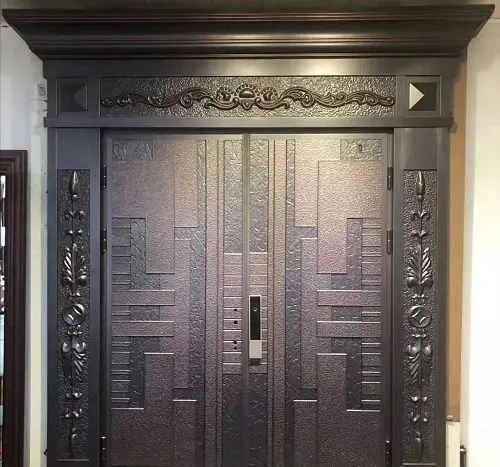
Powder coating: It offers a wide range of choices from smooth and flat to various textures (such as orange peel, sand texture, hammer texture). Its high thickness characteristic makes the touch feel fuller and warmer. In terms of color and gloss retention, as the powder particles melt and flow during curing, the formed surface is free of brush marks and sagging, with excellent consistency.
Liquid paint: In achieving a mirror-like finish with extremely high gloss and very complex color gradient effects, liquid paint still has certain advantages at present, especially suitable for some custom scenarios with extremely high artistic requirements. However, it is also more prone to appearance defects such as uneven spraying, sagging, and orange peel.
2. Environmental friendliness and productivity
Powder coating: This is one of its most advantageous fields. The entire process emits no volatile organic compounds (VOCs) and is harmless to the atmosphere. The over-sprayed powder can be collected through the recovery system and reused, with a material utilization rate as high as over 95%. This not only reduces waste but also saves costs for enterprises.
Liquid paint: Traditional paint contains up to 40% to 60% solvents, all of which volatilize into the atmosphere during curing and are the main source of VOCs. Expensive waste gas treatment equipment is required to meet the emission standards. Meanwhile, the over-sprayed parts of the paint are difficult to recycle, and the actual utilization rate may only be 40% to 60%.
Theme Four: Economy and Applicable Scenarios - There is no Best, only the Most Suitable
In the long run, which coating can bring about a lower total cost of ownership?
1.Initial investment and long-term maintenance
Powder coating: Although the initial investment in the production line is relatively high, it can achieve the required thickness in a single coating, with a high degree of automation and low labor costs. Combining its outstanding durability and low maintenance requirements, its total cost of ownership is usually lower throughout the entire product life cycle.
Liquid paint: The initial equipment and material costs may be relatively low, but it requires skilled workers to operate, and multiple spraying and sanding processes extend the production cycle. Thinner paint films and relatively weaker durability may mean that maintenance or replacement needs to be carried out earlier, thereby increasing long-term costs.
2. How to make a wise choice for your project?
After understanding the characteristics of the two technologies, you can make judgments based on specific application scenarios:
Powder coating is preferred if your project is
High-strength commercial and industrial doors: such as those in factory workshops, warehouses, hospitals, and schools, which need to withstand frequent use and physical wear and tear.
High humidity or corrosive environments: such as coastal areas, food processing plants, and chemical storage areas.
Projects that emphasize environmental protection certification and sustainable development: such as LEED-certified buildings.
Pursue stable and uniform mass production: high consistency in color and quality is required.
Liquid paint can still be considered if your requirements are:
Special artistic effects: Complex multi-color patterns, extremely high mirror-like luster or customized color gradients are required.
On-site repair or small-batch customization: For installed doors or special components that cannot enter large-scale spray lines, the on-site construction flexibility of liquid paint is higher.
Coating for heat-sensitive substrates: Powder spraying requires high-temperature curing and is not suitable for wood or certain plastics.
Conclusion: Invest for long-term value
When choosing the coating for steel doors, it is far more than just a simple "appearance" selection, but a strategic decision concerning performance, efficiency and environmental responsibility. Powder coating technology has established a leading position in modern industrial applications with its outstanding durability, efficient production process and unparalleled environmental advantages. It represents a manufacturing philosophy that focuses on the entire product life cycle and is more intelligent and far-sighted.